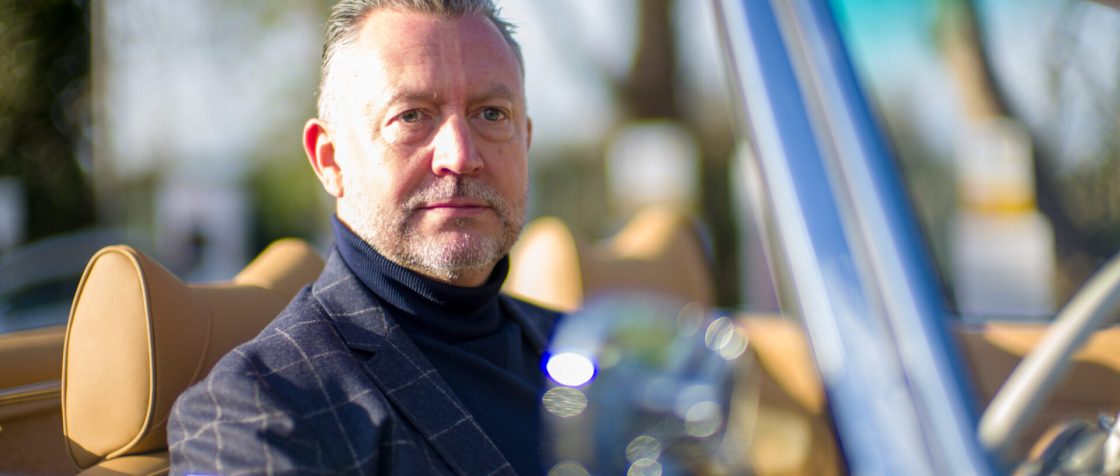
Written By: Justin Lunny, Founder & CEO of Everrati
In an age obsessed with the future, there’s something almost radical about looking back. Not to replicate, but to restore. To ask: What if the past held answers we still need? What if beauty, heritage, and sustainability weren’t at odds… but part of the same story?
You don’t usually associate a 1991 Porsche 911 Wide Body with sustainability. For decades, sustainability and luxury were viewed as incompatible. One was about restraint, the other about indulgence. But today, that binary is breaking down. In fashion, food, architecture—and now, automotive design—we’re seeing a convergence: luxury that respects the planet and sustainability that values heritage. And if you take the 911 at face value, it’s a symbol of automotive decadence. But that’s precisely why it deserves a second life.
Take the iconic 964 and reengineer it with an all-electric powertrain and it now boasts 500bhp, a sub-four-second 0–62mph time, carbon fiber bodywork, and a near-perfect weight balance. But those specs only scratch the surface. These specs place the redefined 964 squarely in the modern performance category. But, what’s more compelling is the underlying ethos. Carbon fiber, once associated with racing excess, is now being engineered for lightweight efficiency. According to the International Energy Agency (IEA), reducing vehicle weight by 10% can improve fuel economy or range by 6–8%, which is critical for EVs managing battery loads. In this sense, performance and sustainability are no longer opposites; they’re co-pilots.
Because when we talk about sustainability, the conversation shouldn’t start and end with emissions. It’s about preserving value—culturally, materially, and emotionally. Cars like this Porsche weren’t meant to sit under dust covers or decay in barns. They were designed to be driven. And that, in essence, is what sustainability means: not discarding the old, but elevating it for the future.
We’re seeing the term “circular economy” used more often across industries from fashion to architecture. Automotives must not be left behind in this conversation. For decades, our sector has operated on a linear model: build, drive, dispose. But make no mistake: this isn’t about gutting a car and dropping in a battery. It’s about engineering with intention.
Across luxury sectors, there’s a growing expectation that brands tread carefully when updating icons. Whether it is fashion houses revisiting archival silhouettes with sustainable fabrics, or architects retrofitting historical buildings for carbon neutrality, the blueprint is clear: innovation should amplify legacy, not erase it. The automotive industry, with its deeply emotional ties to design and provenance, is both uniquely positioned and deeply challenged to do the same.
For Everrati in fact, reversibility is built into our design principles. Even after conversion, the EV powertrain can be removed, and the car returned to its original spec—something few would ever do, but the principle matters. We’re not replacing history when we re-engineer vehicles as all-electric; we’re safeguarding it.
This approach also challenges outdated notions of luxury. Today’s most forward-thinking collectors aren’t just asking, “How fast does it go?” They’re asking, “How does this reflect my values?” A sustainable, redefined 964 says: I respect heritage, but I’m not stuck in it. I want beauty, but not at the cost of progress.
To me, that’s the future of luxury mobility: not mass production or disposable tech, but engineering that endures. We’re not interested in the latest gadget for gadget’s sake. We’re interested in timelessness—how a car can be as relevant, as beautiful, and as exhilarating 30 years from now as it was the day it was made.
Sustainability in our world isn’t just about less. For me, it’s about more. More life. More meaning. More opportunity to reconnect with what matters. For our clients, that could be the car their parents once drove. Or the dream they couldn’t afford in their twenties, but now want to pass down to their children—with the future built in.
The truth is, most of the cars we work with were built in a different era. But with care, skill, and vision, they don’t have to stay there. In redefining these icons, we’re not just extending their road life—we’re redefining what sustainability in luxury can look like.
Because the most sustainable car isn’t always the newest. Sometimes, it’s the one that’s been waiting—for a second chance, and the right hands to restore it.
About the author
Justin Lunny is a seasoned entrepreneur, investor and innovator with over 30 years of experience across fintech, automotive, education, and sustainability. He has co-founded and scaled multiple startups globally, with a focus on strategy, international growth and strategic partnerships. As Founder & CEO of Everrati Automotive, Justin leads the redefinition of iconic cars into high-performance, zero-emission electric vehicles. He’s driven by a mission to merge heritage with innovation and create meaningful impact through sustainable technology.