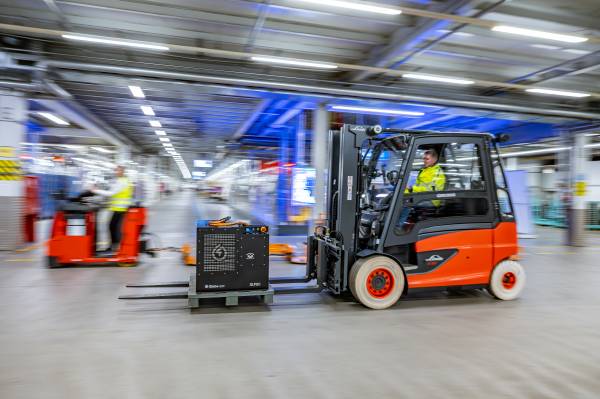
Use of hydrogen in intralogistics – components delivered to all production areas by hydrogen-powered tugger trains and forklift trucks
Gradual transition from electric to hydrogen propulsion by 2030
Use of hydrogen in intralogistics – components delivered to all production areas by hydrogen-powered tugger trains and forklift trucks
Gradual transition from electric to hydrogen propulsion by 2030
Regensburg. BMW Group Plant Regensburg plans to utilise hydrogen for its production logistics going forward. Starting in 2026, hydrogen-powered tugger trains and forklift trucks will be deployed for all transport and logistics tasks. This includes operations in the press shop, body shop and assembly, ensuring that the necessary components and individual parts are delivered to the correct locations for installation.
The project aims to capitalise on the benefits of hydrogen propulsion. “The gradual transition from electric to hydrogen propulsion brings us another step closer to the BMW iFACTORY, our digital and sustainable factory of the future,” says Armin Ebner, head of BMW Group Plant Regensburg.
“Switching production logistics from electricity to hydrogen will diversify our plant’s energy mix – while optimising logistics processes and saving valuable space,” explains Project Manager Katharina Radtke. “The advantage of hydrogen is that refuelling is very fast – just like with conventional fuels. The filling stations required for this will be installed directly within the different production areas and do not take up much space.”
The entire logistics fleet at the Regensburg plant is currently being equipped with electric drive trains. The batteries used in the industrial trucks need to be changed twice per shift. Battery replacement, which is performed manually using a crane, takes about 15 minutes and requires space.
To ensure the wide-scale supply of hydrogen in the future, BMW Group plant Regensburg will install a two-kilometre-long pipeline network, with six decentralised filling stations, between now and early 2026. These stations will supply the logistics fleet in the various production areas with hydrogen, delivered in special trailers that can also be used for interim storage. “Once the conversion is completed, our annual hydrogen consumption will be around 150 tonnes,” says Radtke.
The logistics fleet at BMW Group Plant Regensburg currently comprises about 230 tugger train haulers and forklift trucks. The transition will be completed in stages by 2030.
To provide the best experiences, we use technologies like cookies to store and/or access device information. Consenting to these technologies will allow us to process data such as browsing behavior or unique IDs on this site. Not consenting or withdrawing consent, may adversely affect certain features and functions.
Functional
Always active
The technical storage or access is strictly necessary for the legitimate purpose of enabling the use of a specific service explicitly requested by the subscriber or user, or for the sole purpose of carrying out the transmission of a communication over an electronic communications network.
Preferences
The technical storage or access is necessary for the legitimate purpose of storing preferences that are not requested by the subscriber or user.
Statistics
The technical storage or access that is used exclusively for statistical purposes.The technical storage or access that is used exclusively for anonymous statistical purposes. Without a subpoena, voluntary compliance on the part of your Internet Service Provider, or additional records from a third party, information stored or retrieved for this purpose alone cannot usually be used to identify you.
Marketing
The technical storage or access is required to create user profiles to send advertising, or to track the user on a website or across several websites for similar marketing purposes.